

Studio Apostoli – Andrea, more than 20 years ago, when wellness was a luxury to the most unknown and the term SPA indicated a joint-stock company, you deposited the “Wellness Design” brand and gave life to the first magazine dedicated to the design and management of SPAs and Wellness Centres. An intuition that has led you to be one of Italy’s forerunners in the sector. Tell us how the project for the magazine “Wellness Design” was born
Andrea Zanini Vallin – A bit of history in order to explain and understand each other better: in the 80s we opened one of the first “mixed” engineering companies in our family; in the ’90s with my wife and partner AnnaGrazia Tamborini, an architect, we made the publishers on behalf of third parties and produced material for magazines such as L’Ingegnere Libero Professionista (National Union of Free Professional Engineers), Il Giornale dell’Ingegnere (Milan College of Engineers and Architects), U&C (UNI, CEI, etc.), TSPORT, Professione Progetto, often and willingly confronting ourselves with properties to which, especially for personal reasons, it was difficult to understand the importance of the advent of the internet (in 1996 we opened our first website, inn. it) and what this would entail.

Andrea Zanini Vallin
So in 2000 we registered and edited Wellness Design, aimed at the design and management of wellness, hospitality and buildings for the city. The word “wellness” was still little used and many people pronounced it “vèlnes”, in German (mostly referring to steel tubs) and we were the first to use it in the name of a newspaper. “Wellness Design” was not yet as commonly used as it is now, which allowed us to register it and launch it into the world of communication, media and events.
The fact that we have professionally and editorially dealt with different but related topics, has meant that in us and therefore in Wellness Design there was that curiosity and the ability to support and relate to each other, different subjects and professional areas. This still allows us today to set topics, “read” trends and often the future of our sector, share our reasoning with the professionals who work with us, confront with them and develop initiatives and events. I would say that the term “Wellness Design” is the best and most immediate example of the above.
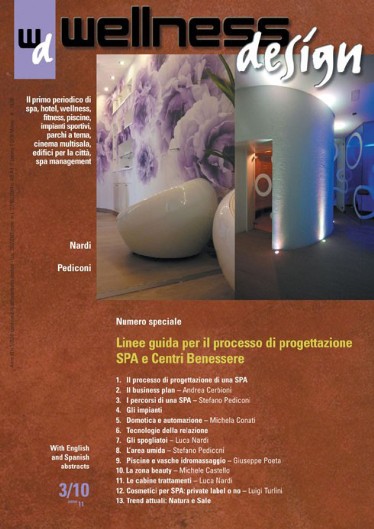
Since 2010 we have also begun to publish in the magazine the “Guidelines for the design and management of spas and wellness centres”, aware of the fact that we have not approached this sector as “well known”, but we have made, continue and will continue to make ourselves – happy with our choice – what we can call “a bunch a lot”, so that we can deal with the various current topics and those that will arise with a minimum of rationality and knowledge of our own.
SA – From its beginnings until today, how have you seen the SPA sector evolve? What have been the substantial changes you have witnessed? What do you foresee for the future? What are the types of SPAs that, in your opinion, have the greatest margin for success?
AZV – First of all I would start from the fact that by now the word “wellness” and often the word “wellness” are normally used in many different contexts, mostly different from the ones we started from. Sometimes I would think that these terms are a bit inflated and abused, but… Wellness in any context has become something essential today. In the same way, spas, which were part of a world that I would define as elite, have become – especially in the hotel sector – a service that you have to have in order to be competitive (regardless of the fact that the data say that those who look for a SPA among what the hotel offers when choosing it on the internet, very often do not use it).
The demand for wellness, intended as an increase in the number of SPAs, has meant that many new companies have appeared on the market and proposed new ones linked to the sale of equipment and materials, unfortunately often not up to the situation. The same is true for design, management, personnel, consultancy, communication and marketing. And training and information on the market have certainly not helped…
The period of closures that we have been through and in part still go through has accelerated and accentuated the growth and development of small wellness environments, inside hospitality structures or in “home” spaces. The “pampering” is even more appreciated and in demand, as is the search for privacy. This offer is already clear and established in the luxury sector and is now quickly being extended to all sectors.
The future of the SPA – as of all facilities, I would say – will certainly be green, sustainable, personalised. The “personal” nature of the wellness concept will make increasingly important analysis and preliminary studies necessary to develop a structure in all its components capable of approaching the market and remain there over time (therefore producing profits).
As far as professionalism, spaces and activities of the future are concerned, I think that psychology and the psychological aspect will assume more and more weight and importance in everything that is wellness, hospitality, wellness and SPA.
SA – In all these years you will have seen hundreds of projects, in Italy and abroad. What are the most common errors you find in the design, construction, management and communication of SPAs? Do you think that the level of preparation of Italian professionals in these areas is adequate?
AZV – At a design level I could say that the most common problems are found in the paths (shoes and bare feet), in the lack of spaces and places for staff, technical rooms to serve the equipment, warehouses, water collection in the different environments, humidity prevention, and the creation of suitable changing rooms.
Often these drawbacks also derive from choices made by the entrepreneur and the lack of comparison between those who design the spa and those who will have to manage it (spa director/spa manager); lack of comparison that also occurs with those who will be in charge of communication and those who will be in charge of marketing. It is not uncommon for a structure to be built and we still do not know who will manage it, who will make communication and who will take care of marketing.
And thinking, designing, building and managing a SPA is a team effort.
At entrepreneurial level, the most recurrent error found is that of entrusting a single entity – company, consultant, designer, future manager, etc. – with the management of a SPA. – the conception, design and implementation of the SPA; experience shows how “all-round experts” inevitably cause serious damage.
Freewheeling, we can then say that we have seen cases in which the entrepreneur claimed to have come across a beautiful SPA in the north and wanted to recreate it as it is in completely different contexts, 1,000-1,500 km further east, west or south.
There have been occasions when the entrepreneur’s consultants have stated that they had been to all the trade fairs in the last two to three years – which one? – and therefore now they knew everything and could consider themselves experts.
Another basic mistake we have come across is the belief that everyone has the skills to run and manage a spa and/or wellness centre or hospitality facility; it goes without saying that not everyone has the character and personality to do this.
If we are talking about management, it should be remembered that the SPA is a company and as such must produce profits.
Other critical aspects that are not difficult to find are reception and receptionists who are not up to the task, low-profile internal and external communication (it is not enough to write a few articles to “sell” the structure to potential clients to define themselves as experts), insufficient sustainability and energy saving.
However, we cannot underline the negative aspects alone without acknowledging the merits of a minority (unfortunately silent) of professionals in the various sectors, capable and experienced, able to carry out and conduct activities of marked charm and attractiveness as well as profitable.
And for this reason, within the editorial philosophy of Wellness Design, when we decide to publish something, we underline its positive aspects and value, because in our opinion it deserves attention.
SA – In addition to editing the magazine, you have always been involved in events, exhibitions, training courses and other activities useful for spreading the culture of well-being. What are the most successful initiatives?
AZV – One of the big “black holes” and problems in this sector that we immediately encountered, together with gaps in legislation and lack of recognition of the professional figures involved, is the lack of information and promotion of its correct dynamics and culture. Hence the birth in 2004 of our seminars (paid or not) and our courses, held only by experienced professionals, open to all involved professionals and students.
The duration is variable and ranges from one-day seminars to nine-day courses dedicated to hotel design. Over the years, more than a thousand people have taken part in seminars and courses organised directly by us and then held outside of trade fair events. And I must say with great pleasure and satisfaction that we are still in contact with most of the participants as well as on good terms.
We did not invent the co-marketing between companies under the direction of one or more experienced designers during the trade fair events, but simply revised them and they had an important development and participation until the trade fairs had the opportunity and believed in the importance of providing culture and information.
At a time when this approach was lacking in favour of the recognition of the sole mission of selling commercial square metres, exhibitions with a cultural content were reduced and disappeared, and the spaces dedicated to congresses during these events were expanded, spaces that were then solved in terms of selling the stands to paying companies with very little cultural implications.
We are waiting for the concrete “reopening” of dedicated travel and meeting places to return to talk and discuss live on the topics we have been discussing for years; and to be honest I must say that we have already received several requests and expressions of interest in this sense, both from professionals and companies, participants and sponsors.
SA – To conclude… when, instead of telling them, you have the chance to take the time to live them, the SPAs, what kind do you prefer? What are the treatments you are looking for? Which SPA, instead, (without naming names) would you never go to?
AZV – If I have to be honest when I manage to go on holiday and want to relax, I avoid attending spas and similar facilities, so that my brain does not have to dedicate itself to work concepts, which is almost impossible when you are forced to stay in a hotel and use a reception, a room, a bathroom and…
Concerning relaxation I am really not very original and very aligned with what emerges during the meetings organized by us, i.e. I prefer the immersion in nature and the contact and presence of the element water.
progetto@wellness-design.info